Why AI & ML Development Services Are Important for AI-Driven Business Innovation
Table of Contents
Artificial intelligence is no longer limited to research labs or large technology companies.
Today, businesses across healthcare, finance, ecommerce, logistics, education, manufacturing, and real estate use AI to automate work, improve customer experiences, and increase productivity.
As a result, AI & ML development services have become a business necessity rather than an experimental technology.
Businesses are no longer experimenting with AI.
They need scalable AI solutions that improve efficiency, automate operations, and support digital transformation.
AI Is Becoming Core Business Infrastructure
Technology leaders increasingly treat AI as the next foundational layer of business infrastructure, much like cloud computing once became. Microsoft CEO Satya Nadella has said that every company will eventually become an AI-powered company as intelligent systems weave deeper into everyday operations. Nvidia’s Jensen Huang echoes this view, describing AI as a “new industrial revolution” for its impact on productivity, automation, and enterprise innovation.
The numbers back this up. Recent enterprise studies suggest that close to 88% of organizations now use AI in at least one business function, and more than 80% plan to increase their AI investment over the next two years. In short, AI is graduating from an optional upgrade to core business infrastructure.
Why Businesses Increasingly Rely on AI and ML
Modern companies generate enormous volumes of data through websites, mobile apps, CRMs, IoT devices, cloud platforms, and everyday digital interactions. At scale, analyzing all of this by hand is nearly impossible.
That is exactly where AI and ML services help. Using intelligent algorithms and predictive models, they automate analysis, sharpen forecasting, streamline workflows, and deliver faster, smarter customer experiences.
AI as the Foundation of Digital Transformation
Digital transformation used to mean cloud migration, a modern website, or a mobile app. Now, AI integration sits at the center of enterprise modernization.
Organizations are using AI to:
- Automate repetitive tasks
- Personalize customer experiences
- Predict customer behavior
- Improve cybersecurity
- Make faster business decisions
Market research consistently shows that companies deploying AI-powered automation tend to see measurable gains in both efficiency and customer engagement.
AI Adoption Trends Across Industries
AI adoption is growing across nearly every industry. Companies are investing in solutions that automate workflows, improve customer engagement, and make better use of business data.
- Generative AI integration
- Enterprise AI copilots
- Conversational AI systems
- AI-powered search experiences
- Autonomous workflow automation
- Hyper-personalization engines
- AI-driven cybersecurity
- Multimodal AI systems
- Voice-enabled business platforms
Analysts expect global AI spending to keep climbing as companies move from small experimental pilots to full enterprise-wide deployment.
Generative AI Is Reshaping Enterprise Operations
Over the past two years, generative AI platforms have dramatically accelerated enterprise adoption.
Businesses now use AI-generated content, intelligent coding assistants, automated design tools, and AI-powered communication systems to work faster and smarter.
From startups to large enterprises, teams are embedding AI copilots directly into their workflows. OpenAI’s Sam Altman has publicly predicted that AI will fundamentally reshape how businesses operate, communicate, and build products over the coming decade, a shift already visible across industries adopting AI-assisted development, automation, and customer engagement.
What Is AI and ML Development?
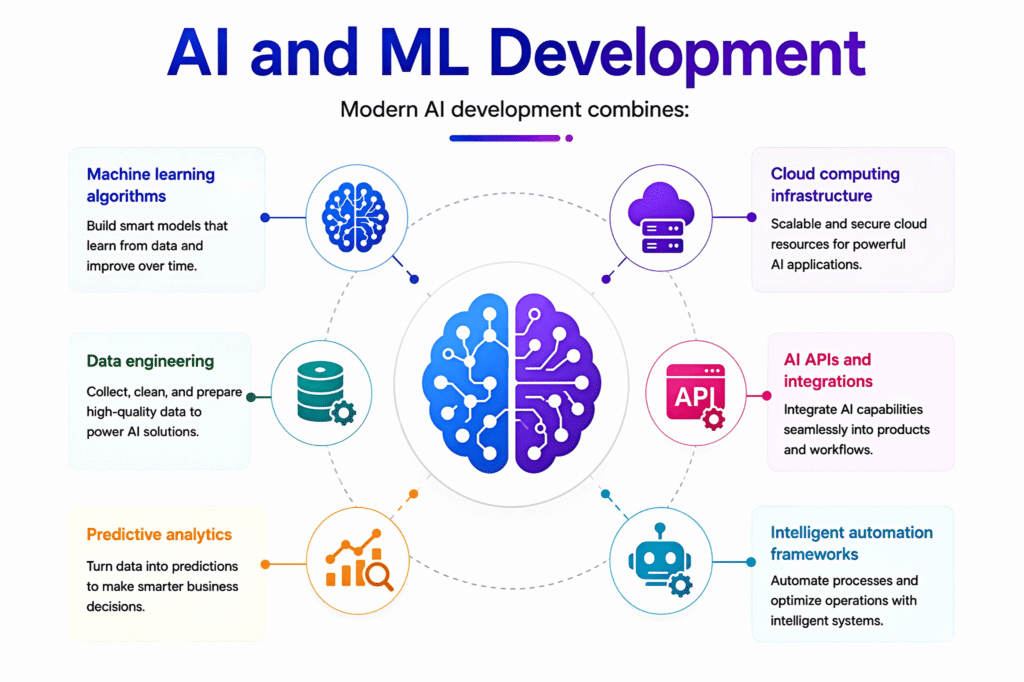
AI and ML development is the process of building intelligent software that can learn from data, recognize patterns, automate decisions, and improve over time.
Artificial Intelligence (AI) aims to simulate human intelligence through technologies like natural language processing, reasoning systems, conversational AI, and computer vision. Machine Learning (ML) is a subset of AI that lets systems learn from historical data on their own, without being explicitly programmed for every task.
Modern AI development typically combines:
- Machine learning algorithms
- Cloud computing infrastructure
- Data engineering
- AI APIs and integrations
- Predictive analytics
- Intelligent automation frameworks
To build scalable systems tailored to their goals, many businesses partner with an experienced AI & ML development company rather than building everything in-house.
What Are the 4 Types of AI?
AI is commonly grouped into four categories based on capability and level of intelligence.
1. Reactive Machines. These systems respond to specific inputs without storing memory or learning from the past. Basic recommendation engines and rule-based automation fall into this group.
2. Limited Memory AI. These systems learn from historical data to improve future predictions and decisions. Most modern business AI operates here, including:
- Predictive analytics
- Autonomous systems
- AI recommendation engines
- Conversational AI platforms
3. Theory of Mind AI. This emerging area focuses on understanding emotions, intentions, and human behavior. It is still in research, but it could shape future customer engagement tools and robotics.
4. Self-Aware AI. A hypothetical stage where systems possess consciousness and self-awareness. Widely discussed in theory, it has not been achieved. A stage where systems possess consciousness and self-awareness. Widely discussed in theory, it has not been achieved.
What Are AI ML Services?
AI ML services cover the full lifecycle of intelligent software: designing, developing, deploying, and maintaining systems that automate workflows and strengthen decision-making. Common offerings include:
- Custom AI software development
- Machine learning model development
- AI chatbot solutions
- Predictive analytics systems
- Natural language processing applications
- Computer vision solutions
- AI automation systems
- Recommendation engine development
- AI cloud integration
- Enterprise AI consulting
To get industry-specific platforms rather than generic tools, businesses increasingly turn to a custom AI development company.ny. platforms rather than generic tools, businesses increasingly turn to a custom AI development company.
What’s the Main Difference Between AI and ML?
Artificial Intelligence is the broad goal of building machines that can perform tasks normally requiring human intelligence. Machine Learning is a specialized branch of AI focused on systems that learn from data automatically.
Put simply:
- AI is about intelligent behavior.
- ML is about learning from data patterns.
For example, AI powers a conversational assistant, while machine learning makes that assistant smarter by analyzing user interactions and behavioral trends over time.
What Does an AI ML Developer Do?
An AI ML developer builds, trains, tests, and deploys intelligent systems that automate operations and process large datasets efficiently. Their work usually includes:
- Developing machine learning algorithms
- Training predictive models
- Optimizing AI systems
- Managing AI infrastructure
- Integrating AI APIs
- Building intelligent automation workflows
- Improving model accuracy and scalability
As adoption grows, these developers are becoming central to enterprise innovation, operational modernization, and the AI trends shaping web development in 2026.
AI Features Businesses Now Want Across Every Industry
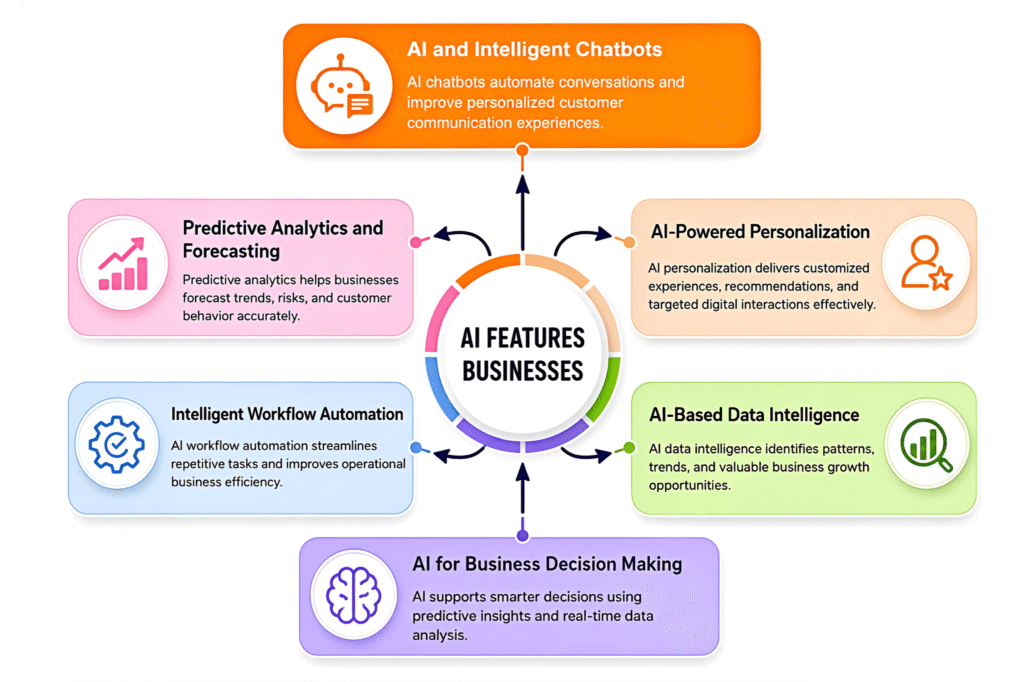
Companies are actively seeking AI capabilities that improve automation, personalization, efficiency, and customer engagement. A few stand out.
Conversational AI and Intelligent Chatbots
Today’s chatbots go far beyond scripted responses. Modern conversational AI understands user intent, Today’s chatbots go far beyond scripted responses. Modern conversational AI understands user intent, reads context, and delivers personalized interactions across websites, apps, and messaging platforms. Businesses use it for:
- Customer support automation
- Lead qualification
- Appointment scheduling
- Ecommerce assistance
- Internal employee support
- Healthcare communication
Industry reports indicate that AI-powered support can cut response times sharply while lifting customer satisfaction.
Predictive Analytics and Forecasting
Predictive analytics is one of the most valuable enterprise AI applications. It helps businesses anticipate customer behavior, operational risks, inventory demand, and sales trends. Sectors actively using it include ecommerce, healthcare, finance, logistics, retail, and manufacturing. Companies that adopt it often see meaningful gains in planning accuracy and forecasting.
AI-Powered Personalization
Consumers now expect experiences tailored to them. AI helps businesses deliver personalized product recommendations, content suggestions, targeted campaigns, and customized communication. This approach is now common across streaming platforms, ecommerce, edtech, healthcare, financial services, and travel technology. Research suggests that personalization strategies tend to strengthen engagement and improve conversion rates.
Intelligent Workflow Automation
AI-powered automation helps organizations reduce repetitive tasks while improving speed and consistency. Popular use cases include:
- Invoice processing
- CRM automation
- HR onboarding
- Support ticket routing
- Compliance monitoring
- Document verification
Rather than treating AI as an add-on, many enterprises are now redesigning their entire operations around it.
AI-Based Data Intelligence
Companies produce huge amounts of customer and operational data every day. AI-powered analytics surfaces trends, anomalies, behavioral patterns, and new opportunities far faster than traditional reporting. In practice, it improves strategic planning, customer targeting, revenue forecasting, operational visibility, market analysis, and overall performance.
Why Businesses Prefer Custom AI Development Companies
Many organizations choose a custom AI development company over off-the-shelf products, and for good reasons.
Industry-Specific Solutions
Every industry runs on different workflows. A healthcare provider needs very different AI capabilities than a logistics operator or an ecommerce platform. Custom development produces systems built around a company’s actual goals and industry challenges.
Better Scalability and Integration
Custom AI fits more cleanly into existing infrastructure, including CRMs, ERPs, cloud environments, mobile apps, and enterprise platforms. That translates into stronger long-term scalability and more consistent operations.
Greater Data Security and Control
Companies handling sensitive customer or operational data often prefer custom AI environments, which offer tighter compliance controls, more infrastructure flexibility, and stronger data governance. Sensation Software Solutions helps enterprises build secure AI systems for healthcare, finance, insurance, and other data-sensitive environments.
What Is AI and ML Development?
AI adoption is set to accelerate as businesses invest more heavily in intelligent automation, predictive intelligence, and enterprise AI infrastructure. Key trends shaping what comes next include:
- Enterprise AI copilots
- Autonomous workflow systems
- Generative AI integration
- AI-driven cybersecurity
- Hyper-personalized digital experiences
- Voice-enabled enterprise platforms
- Multimodal AI systems
- AI-powered search ecosystems
Over the next decade, AI-powered operations are expected to keep transforming healthcare, finance, retail, manufacturing, logistics, education, and enterprise software. Contact us today to explore future-ready AI solutions for your business.
If you’re considering enterprise-grade AI, it’s worth exploring advanced AI & Machine Learning development services built to support intelligent automation, predictive analytics, and scalable, AI-driven innovation.
Why Businesses Prefer Custom AI Development Companies
An AI ML developer builds, trains, tests, and deploys intelligent systems that automate operations and process large datasets efficiently. Their work usually includes:
- Developing machine learning algorithms
- Training predictive models
- Optimizing AI systems
- Managing AI infrastructure
- Integrating AI APIs
- Building intelligent automation workflows
- Improving model accuracy and scalability
As adoption grows, these developers are becoming central to enterprise innovation, operational modernization, and the AI trends shaping web development in 2026.
AI Features Businesses Now Want Across Every Industry
Companies are actively seeking AI capabilities that improve automation, personalization, efficiency, and customer engagement. A few stand out.
Predictive Analytics and Forecasting
Predictive analytics is one of the most valuable enterprise AI applications. It helps businesses anticipate customer behavior, operational risks, inventory demand, and sales trends. Sectors actively using it include ecommerce, healthcare, finance, logistics, retail, and manufacturing. Companies that adopt it often see meaningful gains in planning accuracy and forecasting.
AI-Powered Personalization
Consumers now expect experiences tailored to them. AI helps businesses deliver personalized product recommendations, content suggestions, targeted campaigns, and customized communication. This approach is now common across streaming platforms, ecommerce, edtech, healthcare, financial services, and travel technology. Research suggests that personalization strategies tend to strengthen engagement and improve conversion rates.
What Are AI ML Services?
AI ML services cover the full lifecycle of intelligent software: designing, developing, deploying, and maintaining systems that automate workflows and strengthen decision-making. Common offerings include:
- Custom AI software development
- Machine learning model development
- AI chatbot solutions
- Predictive analytics systems
- Natural language processing applications
- Computer vision solutions
- AI automation systems
- Recommendation engine development
- AI cloud integration
- Enterprise AI consulting
To get industry-specific platforms rather than generic tools, businesses increasingly turn to a custom AI development company.
AI vs. ML: What’s the Difference?
Artificial Intelligence is the broad goal of building machines that can perform tasks normally requiring human intelligence. Machine Learning is a specialized branch of AI focused on systems that learn from data automatically.
Put simply:
- AI is about intelligent behavior.
- ML is about learning from data patterns.
For example, AI powers a conversational assistant, while machine learning makes that assistant smarter by analyzing user interactions and behavioral trends over time.
What Does an AI ML Developer Do?
An AI ML developer builds, trains, tests, and deploys intelligent systems that automate operations and process large datasets efficiently. Their work usually includes:
- Developing machine learning algorithms
- Training predictive models
- Optimizing AI systems
- Managing AI infrastructure
- Integrating AI APIs
- Building intelligent automation workflows
- Improving model accuracy and scalability
As adoption grows, these developers are becoming central to enterprise innovation, operational modernization, and the AI
AI Features Businesses Now Demand Across All Industries
Companies are actively seeking AI capabilities that improve automation, personalization, efficiency, and customer engagement. A few stand out.
Conversational AI and Intelligent Chatbots
Today’s chatbots go far beyond scripted responses. Modern conversational AI understands user intent, reads context, and delivers personalized interactions across websites, apps, and messaging platforms. Businesses use it for:
- Customer support automation
- Lead qualification
- Appointment scheduling
- Ecommerce assistance
- Internal employee support
- Healthcare communication
Industry reports indicate that AI-powered support can cut response times sharply while lifting customer satisfaction.
Predictive Analytics and Forecasting
Predictive analytics is one of the most valuable enterprise AI applications. It helps businesses anticipate customer behavior, operational risks, inventory demand, and sales trends. Sectors actively using it include ecommerce, healthcare, finance, logistics, retail, and manufacturing. Companies that adopt it often see meaningful gains in planning accuracy and forecasting.
AI-Powered Personalization
Consumers now expect experiences tailored to them. AI helps businesses deliver personalized product recommendations, content suggestions, targeted campaigns, and customized communication. This approach is now common across streaming platforms, ecommerce, edtech, healthcare, financial services, and travel technology. Research suggests that personalization strategies tend to strengthen engagement and improve conversion rates.
AI-driven personalization is now widely used across:
• Streaming platforms
• Ecommerce systems
• EdTech applications
• Healthcare platforms
• Financial services
• Travel technology
Market research suggests that businesses using AI personalization strategies often experience stronger customer engagement and higher conversion performance.
Intelligent Workflow Automation
AI-powered automation helps organizations reduce repetitive tasks while improving speed and consistency. Popular use cases include:
- Invoice processing
- CRM automation
- HR onboarding
- Support ticket routing
- Compliance monitoring
- Document verification
Rather than treating AI as an add-on, many enterprises are now redesigning their entire operations around it.
AI-Based Data Intelligence
Organizations generate massive amounts of customer and operational data daily. AI-powered analytics systems help identify trends, anomalies, behavioral patterns, and business opportunities much faster than traditional reporting methods.
AI-based business intelligence improves:
Companies produce huge amounts of customer and operational data every day. AI-powered analytics surfaces trends, anomalies, behavioral patterns, and new opportunities far faster than traditional reporting. In practice, it improves strategic planning, customer targeting, revenue forecasting, operational visibility, market analysis, and overall performance.
Why Businesses Prefer Custom AI Development Companies
Many organizations choose a custom AI development company over off-the-shelf products, and for good reasons.
Industry-Specific Solutions
Every industry runs on different workflows. A healthcare provider needs very different AI capabilities than a logistics operator or an ecommerce platform. Custom development produces systems built around a company’s actual goals and industry challenges.
Better Scalability and Integration
Custom AI fits more cleanly into existing infrastructure, including CRMs, ERPs, cloud environments, mobile apps, and enterprise platforms. That translates into stronger long-term scalability and more consistent operations.
Greater Data Security and Control
Companies handling sensitive customer or operational data often prefer custom AI environments, which offer tighter compliance controls, more infrastructure flexibility, and stronger data governance. Sensation Software Solutions helps enterprises build secure AI systems for healthcare, finance, insurance, and other data-sensitive environments.
Comparison Between Traditional Software and AI-Powered Business Systems
| Feature | Traditional Software Systems | AI-Powered Business Systems |
|---|---|---|
| Automation Capability | Rule-based automation | Intelligent adaptive automation |
| Data Processing | Manual analysis dependent | Real-time predictive analysis |
| Customer Personalization | Limited | Advanced AI-driven personalization |
| Workflow Optimization | Static workflows | Self-improving operational systems |
| Decision Support | Basic reporting | Predictive recommendations |
| Scalability | Limited flexibility | Highly scalable intelligent systems |
| User Experience | Standard interactions | Context-aware experiences |
| Operational Efficiency | Moderate | High automation efficiency |
Businesses that adopt AI-driven systems consistently report better scalability, faster decisions, and stronger customer engagement than those relying on traditional software alone.
What’s Next for AI and ML Development Services
AI adoption is set to accelerate as businesses invest more heavily in intelligent automation, predictive intelligence, and enterprise AI infrastructure. Key trends shaping what comes next include:
- Enterprise AI copilots
- Autonomous workflow systems
- Generative AI integration
- AI-driven cybersecurity
- Hyper-personalized digital experiences
- Voice-enabled enterprise platforms
- Multimodal AI systems
- AI-powered search ecosystems
Over the next decade, AI-powered operations are expected to keep transforming healthcare, finance, retail, manufacturing, logistics, education, and enterprise software. Contact us today to explore future-ready AI solutions for your business.
If you’re considering enterprise-grade AI, it’s worth exploring advanced AI & Machine Learning development services built to support intelligent automation, predictive analytics, and scalable, AI-driven innovation.
Frequently Asked Questions
What are AI ML services?
AI ML services include AI application development, predictive analytics, intelligent automation, machine learning model development, chatbot creation, and enterprise AI integration.
What industries use AI and ML services?
Industries such as healthcare, finance, ecommerce, education, manufacturing, logistics, and real estate actively use AI-powered technologies.
What is the difference between AI and ML?
AI is the broader concept of machine intelligence, while machine learning is a subset of AI focused on systems learning automatically from data.
Why do businesses hire custom AI development companies?
Businesses prefer custom AI development companies because they provide tailored AI systems aligned with operational workflows, scalability goals, and industry-specific requirements.
What does an AI ML developer do?
An AI ML developer builds, trains, deploys, and optimizes intelligent systems capable of automating business operations and improving data-driven decision-making.