How Do React and Node.js Enhance Web Application Performance in Modern Development?

Table of Contents
Performance isn’t a nice-to-have anymore -it’s the difference between a user staying on your app or bouncing to a competitor’s. As web applications get more interactive, data-heavy, and real-time, the technology stack behind them matters more than ever. That’s exactly why React JS development paired with Node.js has become the default choice for businesses building fast, scalable, modern web applications in 2026.
This post breaks down exactly how React and Node.js improve performance, why they work so well together, and when they’re the right choice for your next project.
React and Node.js: A Quick Overview
React is a JavaScript library for building user interfaces, maintained by Meta and a large open-source community, while Node.js is a JavaScript runtime that lets developers run JavaScript on the server. Together, they let teams build both the front end and back end of an application in a single language -JavaScript.
According to the State of JS 2025 survey, Node.js holds roughly 90% share among JavaScript-based backend runtimes, while React leads at around 69.9% developer usage in the same survey. Separately, W3Techs’ August 2026 tracking puts Node.js at over 35% of all server-side platform usage globally, and industry data from CMARIX values the JavaScript Web Framework market at $6.81 billion, inside a broader $87.75 billion global web development market.
Understanding ReactJS Role in Modern Web Development
Why should you use ReactJS for web development?
ReactJS is built around a component-based architecture and a virtual DOM, which together solve one of the biggest historical bottlenecks in web development: slow, expensive updates to the browser’s actual DOM. Instead of re-rendering an entire page when data changes, React calculates the minimal set of changes needed and updates only those elements. According to research compiled by eSparkInfo, sites built with React render 15–20% faster than comparable sites built with other JavaScript libraries.
Beyond raw speed, React gives development teams:
- Reusable components that cut development time and reduce bugs
- A large ecosystem per npmcharts data cited by Tech Insider, React logged over 140 million weekly npm downloads in August 2026
- Strong SEO potential when combined with server-side rendering, which industry sources report can improve crawl speed and search ranking versus purely client-rendered pages
- Long-term maintainability, since component-based code is easier to test, debug, and scale
What are the 3 pillars of ReactJS?
 ReactJS performance and popularity rest on three foundational pillars:
- Component-Based Architecture: Every piece of the UI is broken into independent, reusable components (buttons, forms, cards, navigation), each managing its own logic and state.
- Virtual DOM: React keeps a lightweight, in-memory representation of the real DOM, comparing it against the previous version and updating only what actually changed in the browser.
- Unidirectional Data Flow: Data flows in one direction, from parent components to child components, making it easier to debug and predict how a change in data affects the UI as applications scale.
Together, these three pillars are why React applications tend to stay fast and manageable even as features and team size grow.
Why do we use ReactJS in web development?
In practice, teams choose ReactJS for Web Development and React JS Development because it solves real, recurring development problems: slow UI updates, messy state management, and inconsistent UI across large teams. React’s declarative style means developers describe what the UI should look like for a given state, and React handles the how.
With React 19 and the React Compiler, many historical performance bottlenecks around unnecessary re-renders have been addressed automatically – part of why, according to W3Techs’ August 2026 data, React remains the most-used JavaScript framework, with a reported 34–35% share among the roughly 70 frameworks it tracks (figures vary slightly by tracking methodology; Ouranos Tech’s 2026 report puts React’s share of JS-framework-using sites at nearly 70%).
How Node.js Enhances Backend Performance
React handles what users see -Node.js handles what happens behind the scenes, and it’s just as important to overall application performance.
Node.js is built on a non-blocking, event-driven architecture, meaning it can handle thousands of simultaneous connections without creating a new thread for each one. Real-world performance gains reported by Bacancy Technology’s research include page loading time reductions of 50–60% and development cost reductions of up to 58% in some case studies. Netflix and PayPal are both cited by Bacancy as companies reporting significant performance improvements and reduced infrastructure costs after adopting Node.js architecture.
Node.js is particularly well-suited to applications with heavy concurrent traffic, real-time features (chat, notifications, live dashboards), and microservices architectures -common requirements in modern custom web development services engagements.
Why React + Node.js Together Is the Preferred Modern Stack
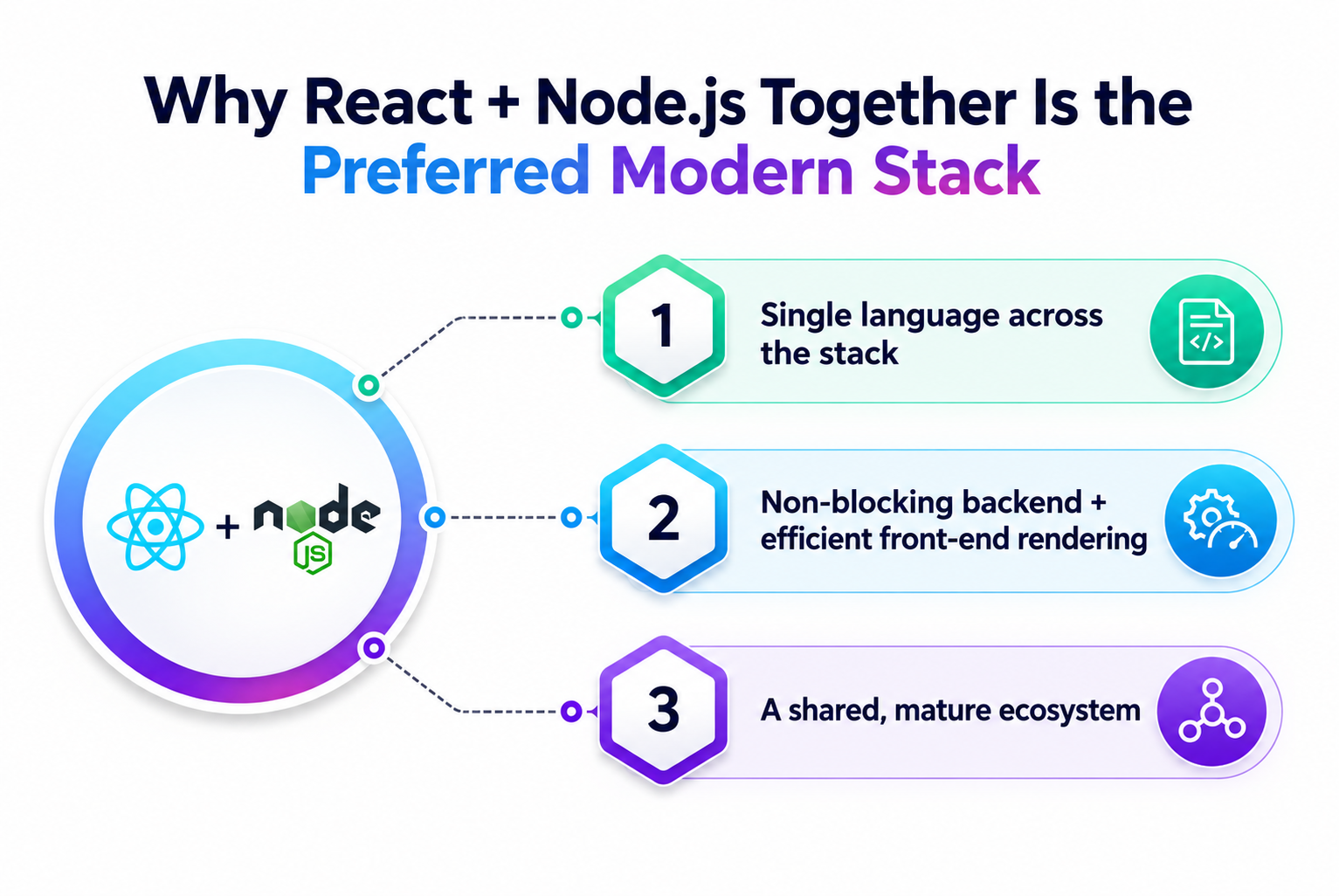 When paired -often as part of the MERN stack (MongoDB, Express, React, Node.js) -React and Node.js create a full-stack JavaScript environment. This matters for performance because:
- Single language across the stack means faster development cycles and fewer context-switching bugs
- Non-blocking backend + efficient front-end rendering keeps applications responsive under real-time data loads
- A shared, mature ecosystem, since JavaScript remains the most widely used programming language among developers globally, at 65.6% usage according to Colorlib’s 2026 developer statistics roundup (sourced from Stack Overflow)
Real-World Performance Benchmarks
For teams evaluating whether React is still the right call in 2026, LogRocket’s 2026 benchmark data (cited by mpiric Software) on React 19.2 shows.
| Metric | React 19.2 |
|---|---|
| First Contentful Paint | 0.8s |
| Total Blocking Time | 0ms |
| Speed Index | 0.8s |
| PageSpeed Score | 82 |
When to Choose React + Node.js for Your Project
This stack tends to be the right fit for:
- Single-page applications (SPAs) and interactive dashboards where UI responsiveness is critical
- E-commerce platforms needing fast page loads and SEO-friendly rendering
- Real-time applications chat apps, live notifications, collaborative tools
- Enterprise web development services projects requiring a scalable codebase across a large team
- Start-ups and MVPs needing to move fast with a single, widely-available skill set
Beyond the Web: React Native and Mobile App Development
The same component-based philosophy behind React extends to mobile app development services through React Native, letting teams reuse much of their React codebase and skill set to build native-feeling iOS and Android apps -one team, one codebase, covering web and mobile.
Choosing the Right React JS Development Partner
These performance gains only materialize with correct implementation – poor component structure or a poorly architected Node.js backend can erase most of these benefits. Working with an experienced Sensation Solutions team for React JS development and full-stack app development services ensures these advantages are realized in production, not just on paper. Contact us to build a high-performing React application tailored to your business needs.
Frequently Asked Questions
What are the 3 pillars of ReactJS?
The three pillars of ReactJS are component-based architecture, the virtual DOM, and unidirectional data flow.
Why do we use ReactJS in web development?
ReactJS solves recurring problems around slow UI updates and hard-to-maintain code, while its declarative approach and strong ecosystem help a Web Development Company speed up development significantly.
Is Node.js better than traditional backend frameworks for performance?
For I/O-heavy, real-time, or high-concurrency applications, Node.js's non-blocking architecture typically outperforms traditional thread-based backend models, per case studies from companies like Netflix and PayPal.
Can React and Node.js be used for mobile app development too?
Yes -through React Native, teams can reuse much of their React codebase to build native iOS and Android apps, a popular approach for unified web and mobile app development services.
Is React still the right choice in 2026?
Yes. Per W3Techs and Ouranos Tech's 2026 tracking, React remains the most widely used JavaScript framework, and React 19's compiler has further improved its default performance.