Blockchain API Testing: What Makes It Unique and Why It Matters

Table of Contents
Blockchain has changed the way digital transactions are recorded, verified, and secured. Instead of relying on a single central authority, it runs on a decentralized, distributed ledger where transactions are confirmed by many participants across a network.
APIs (Application Programming Interfaces) sit at the heart of this system. They act as the bridge between decentralized blockchain networks and everyday applications, including web platforms, enterprise systems, and mobile apps.
Here’s the catch: testing blockchain APIs is not the same as testing traditional ones. Blockchain systems bring a unique mix of properties that standard API testing simply isn’t built for:
- Decentralized architecture
- Immutable data
- Smart contracts
- Cryptographic validation
- Consensus mechanisms
As demand grows for secure web development services, software development, and mobile app development, businesses need blockchain APIs that are reliable, secure, and ready to scale. That’s exactly why blockchain API testing has become essential rather than optional.
Understanding Blockchain APIs
What Is a Blockchain API?
What Is a Blockchain API?
A blockchain API lets an application communicate with a blockchain network. In practical terms, it gives developers the ability to:
- Send and receive transactions
- Query blockchain data
- Deploy and interact with smart contracts
- Access wallet services
- Retrieve block and transaction details
Put simply, a blockchain API connects decentralized networks to the centralized and user-facing applications people actually use.
| API Type | Purpose | Common Use Case |
|---|---|---|
| Node APIs | Communicate directly with blockchain nodes | Broadcasting transactions |
| Wallet APIs | Manage wallet creation and transactions | Digital asset transfers |
| Smart Contract APIs | Interact with deployed smart contracts | DeFi, NFTs, token transfers |
| Explorer APIs | Retrieve blockchain data | Transaction tracking |
These APIs enable applications built through software development services and mobile app development services to seamlessly integrate blockchain functionality.
How Blockchain APIs Connect Networks to Applications
Behind every request, a blockchain API handles several steps:
- It converts user requests into transactions the blockchain can read
- It signs those transactions with cryptographic keys
- It broadcasts them to the network’s nodes
- It retrieves validated responses back from the network
This multi-step, security-heavy process is what makes blockchain APIs more complex to test than traditional ones.
How Blockchain API Testing Differs from Traditional API Testing
Traditional API testing usually checks how a server responds to requests. Blockchain API testing goes further, because the underlying technology behaves differently at almost every level.
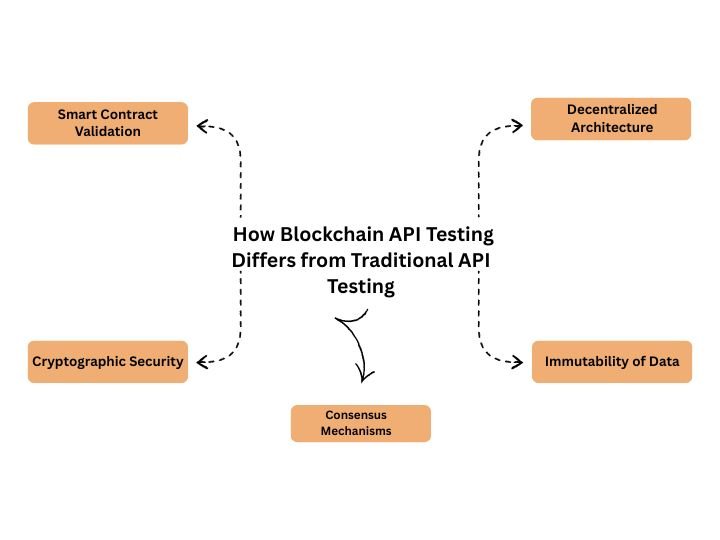
Decentralized Architecture
A blockchain has no central server calling the shots. Instead, it:
- Runs without a central authority
- Relies on peer-to-peer validation
- Verifies activity through a distributed ledger
Testing therefore, has to account for network consensus and node synchronization, not just a single server’s response.
Immutability of Data
Once data is written to a blockchain, it stays there. Transactions are recorded permanently and can’t be edited or deleted.
That permanence raises the stakes. A bug that reaches production can’t simply be reversed, so thorough testing before deployment is critical.
Smart Contract Validation
Smart contracts automatically execute logic-based transactions, which means their code must be tested carefully. Effective testing includes:
- Validating the functional logic
- Checking boundary conditions
- Testing for reentrancy vulnerabilities
- Confirming gas optimization
Weak smart contract testing can lead to financial losses that are impossible to recover.
Cryptographic Security
Blockchain APIs depend heavily on cryptography, including:
- Public and private key validation
- Digital signatures
- Hashing algorithms
- Encryption protocols
Testing must confirm that signatures validate correctly and that transactions are broadcast securely.
Consensus Mechanisms
Different blockchains reach agreement in different ways, such as Proof of Work (PoW), Proof of Stake (PoS), and Delegated Proof of Stake (DPoS). Because of this, testing needs to account for:
- Network confirmation times
- Fork scenarios
- Node synchronization delays
Comparison Table: Traditional API vs Blockchain API Testing
| Aspect | Traditional API Testing | Blockchain API Testing |
|---|---|---|
| Architecture | Centralized | Decentralized |
| Data Modifiability | Editable | Immutable |
| Security Layer | Standard authentication | Cryptographic validation |
| Transaction Finality | Immediate response | Consensus-based confirmation |
| Risk Level | Moderate | High (financial impact) |
Key Challenges in Blockchain API Testing
Testing blockchain APIs comes with hurdles you won’t typically face with conventional systems.
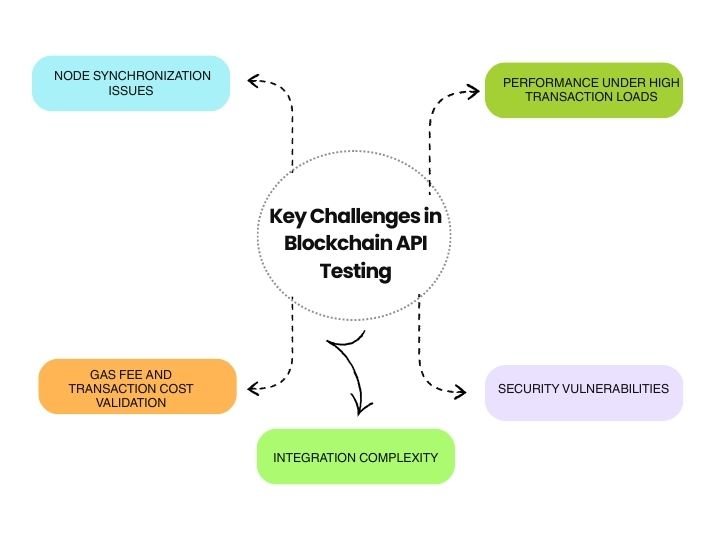
Node synchronization issues. Nodes can experience slight latency differences, which affects how quickly transactions are confirmed.
Performance under heavy load. Tests need to simulate large transaction volumes to measure how well the system scales.
Gas fee and transaction cost validation. Miscalculated gas can cause transactions to fail or become unexpectedly expensive.
Security vulnerabilities. Common threats include 51% attacks, replay attacks, double spending, and smart contract exploits.
Integration complexity. Blockchain APIs often need to connect with payment gateways, enterprise systems, web applications, and mobile apps, which significantly widens the scope of testing.
Why Blockchain API Testing Matters
Rigorous testing isn’t just a technical formality. It directly protects your users, your assets, and your reputation.
Stronger security. Thorough testing helps prevent financial fraud, protect digital assets, and secure the flow of transactions.
Greater reliability. Proper validation supports accurate transaction execution, fewer deployment errors, and stable performance even under heavy load.
Regulatory compliance. Blockchain applications must meet industry data security standards, financial regulations, and data integrity requirements. Testing helps confirm that these obligations are met.
A better user experience. Well-tested APIs deliver faster confirmations, fewer failed transactions, and smoother integration. That reliability is especially important for businesses offering mobile app development services and enterprise-grade web development.
Tools Used for Blockchain API Testing
| Tool | Purpose |
|---|---|
| Postman | API request and response validation |
| Truffle | Smart contract testing framework |
| Hardhat | Ethereum development and testing environment |
| Ganache | Local blockchain simulation |
| JMeter | Performance and load testing |
These tools support professional software development services in delivering reliable blockchain solutions.
Best Practices for Blockchain API Testing
| Best Practice | Why It Matters |
|---|---|
| Use test nets before main net | Prevent irreversible errors |
| Automate smart contract audits | Detect vulnerabilities early |
| Conduct penetration testing | Identify security gaps |
| Monitor latency & throughput | Ensure scalability |
| Continuous Integration (CI/CD) | Maintain testing consistency |
Testing should never be a one-time process, it must be continuous.
Role of Professional Development Teams
Blockchain API testing calls for deep technical expertise across several layers of the stack. The right team makes a measurable difference.
When to Hire Database Developers
Blockchain API testing calls for deep technical expertise across several layers of the stack. The right team makes a measurable difference.
When to Hire Database Developers
It’s worth choosing to hire database developers when you’re:
- Managing blockchain data indexing
- Optimizing off-chain storage
- Handling large transaction datasets
Efficient database management improves performance and reduces API latency.
Why Expert Web Development Services Matter
Professional web development ensures secure frontend integration, real-time transaction updates, and secure wallet authentication.
Why Reliable Software Development Services Matter
Comprehensive software development supports end-to-end blockchain architecture, secure backend systems, smart contract validation, and strong API security.
Blockchain in Mobile App Development
In blockchain-powered apps, wallet integration must be secure, private keys must be protected, and transactions must be verified in real time. Experienced mobile app development teams help businesses adopt mobile blockchain safely.
Future of Blockchain API Testing
Blockchain testing is evolving quickly, and several trends are shaping what comes next:
- AI-driven, automated vulnerability detection
- Cross-chain interoperability testing
- Scalability gains through Layer 2 solutions
- Wider adoption of DeFi, NFTs, and enterprise blockchain
As blockchain ecosystems grow more sophisticated, the frameworks used to test them will need to keep pace.
Final Thoughts
Blockchain API testing stands apart from traditional API testing for five core reasons: decentralization, immutability, smart contract logic, cryptographic security, and consensus mechanisms.
Because blockchain transactions are often irreversible and financial in nature, careful testing isn’t a nice-to-have — it’s essential. Businesses investing in blockchain projects benefit most from partnering with experienced professionals across web development, software development, and mobile app development. The right team is what turns a blockchain idea into a solution that’s secure, scalable, and built to last.
Frequently Asked Questions:
Why is blockchain API testing critical for financial applications?
Because blockchain transactions are irreversible, any error can result in permanent financial loss. Testing ensures security and transaction accuracy.
What are the biggest risks in poorly tested blockchain APIs?
Major risks include smart contract exploits, double-spending, replay attacks, and high transaction costs due to incorrect gas calculations.
Do businesses need to hire database developers for blockchain projects?
Yes, especially when handling off-chain storage, indexing blockchain data, and optimizing performance. It is often necessary to Hire Database Developers for large-scale implementations.
Which tools are commonly used for blockchain API testing?
Popular tools include Postman, Truffle, Hardhat, Ganache, and JMeter.
Can blockchain APIs be integrated into mobile applications?
Yes. With professional mobile app development services, businesses can integrate secure wallets, real-time transaction tracking, and encrypted authentication into mobile apps.