How AI-Powered Content Planning Improves SEO, Research & Content Creation for Better Search Visibility
Table of Contents
Search engines and AI-powered platforms are changing how people find information, compare solutions, and make business decisions. To remain competitive, businesses need more than frequent blog publishing. They need relevant, well-researched content that answers user questions, matches search intent, and demonstrates genuine expertise.
AI-powered content planning helps businesses develop a more structured approach to keyword research, content creation, and search engine optimization. By using artificial intelligence to analyze search queries, identify content gaps, and organize relevant topics, marketers can make informed decisions about what to publish and how to optimize existing website pages.
When combined with human expertise and reliable data, AI can support a stronger SEO content strategy, improve research efficiency, and help businesses create content for traditional search engines and AI-driven discovery platforms.
What Is AI-Powered Content Planning?
AI-powered content planning is the process of using artificial intelligence, search data, and audience insights to research, organize, prioritize, and optimize website content according to business objectives and user needs.
Traditional content planning often involves manual keyword research, competitor analysis, and brainstorming. AI tools can assist with these tasks by identifying related search queries, grouping keywords into relevant topics, analyzing common questions, and suggesting potential content opportunities.
For example, a digital marketing company targeting businesses that want better organic visibility might develop content around AI SEO, keyword research, content optimization, technical SEO, and generative engine optimization.
Instead of publishing unrelated articles, marketers can organize these subjects into a connected content plan that addresses different stages of the customer journey.
An effective AI content strategy combines automated research with human decision-making. AI helps process information and generate ideas, while marketers validate opportunities, check accuracy, and ensure that every article provides genuine value.
How AI-Powered Content Planning Improves SEO
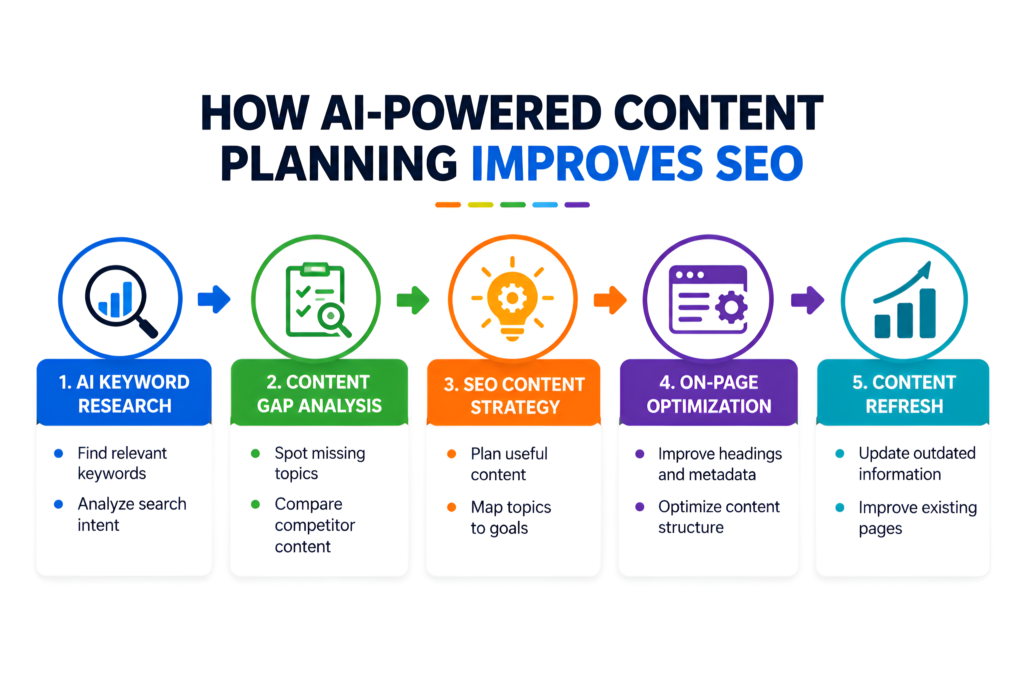
AI can support multiple stages of SEO, from identifying relevant keywords to improving existing pages and measuring content performance.
1. Improves AI Keyword Research and Search Intent Analysis
Keyword research helps marketers understand what their target audience searches for and which topics deserve attention. AI keyword research makes this process more efficient by helping identify keyword variations, related questions, semantic relationships, and potential search intent.
For example, a business targeting the keyword “SEO content strategy” could research related queries such as:
- How can AI improve content planning?
- What are the benefits of AI keyword research?
- Which AI content creation tools help marketers?
- How can businesses optimize content for AI search?
- What is the difference between AEO and traditional SEO?
These queries can reveal opportunities for educational articles, detailed guides, service pages, and FAQs.
AI-generated keyword suggestions should be validated using keyword research platforms, search engine results pages, Google Search Console, and actual customer questions. Search volume, competition, relevance, and business value should all inform the final selection.
The objective is not to target every suggested keyword. It is to select search terms that reflect genuine audience needs and support business goals.
2. Supports Content Gap Analysis
Content gap analysis identifies important topics, questions, or information that a website does not cover adequately. It can also reveal where existing pages fail to satisfy search intent or provide enough useful detail.
AI-assisted content gap analysis helps marketers compare their existing content with relevant competitor pages, audience questions, and related search queries.
For example, competing articles about AI-powered SEO might explain keyword research but offer limited guidance on content quality, topic prioritization, or performance measurement. A business could address these gaps with practical workflows, examples, and clear recommendations.
Content gap analysis can identify three types of opportunities:
- Missing topics: Relevant subjects that have not yet been covered.
- Incomplete content: Existing articles that need additional explanations, examples, or evidence.
- Overlapping pages: Similar articles that may need clearer differentiation, consolidation, or improved internal linking.
AI can accelerate this analysis, but marketers should review the actual pages and validate each recommendation before acting on it. The purpose is to create more useful content, not simply reproduce what competitors publish.
3. Builds a Stronger SEO Content Strategy
An effective SEO content strategy connects keyword research, audience needs, website structure, and business objectives.
AI can help organize related keywords into topic clusters, allowing businesses to create comprehensive resources supported by relevant articles and service pages.
For example, a central article about AI SEO could connect to supporting content covering:
- AI-powered content planning
- AI keyword research
- AI content creation tools
- AI content optimization
- Content gap analysis
- Answer Engine Optimization
- Generative Engine Optimization
This structure helps readers navigate related topics and supports clearer contextual relationships between website pages. Along with Google Business Profile Optimization, businesses can improve their online visibility and maintain consistent information across relevant digital platforms. Each article should have a distinct purpose and address a specific audience need. Publishing multiple pages that answer the same question in nearly identical ways can create unnecessary duplication and weaken the overall content strategy.
4. Improves On-Page SEO and Content Optimization
AI content optimization involves using artificial intelligence to identify opportunities to improve the relevance, structure, clarity, and usefulness of existing or newly created content.
AI tools can assist with reviewing title tags, meta descriptions, heading structures, keyword coverage, internal linking, and readability. They can also identify missing subtopics or sections that do not adequately answer the main query.
For better results, every content brief should define:
- Primary and secondary keywords.
- Target audience and search intent.
- Main question the content must answer.
- Recommended H1, H2, and H3 headings.
- Relevant supporting topics and FAQs.
- Internal links to related website pages.
- Evidence, examples, and expert insights.
- A suitable call to action.
These recommendations should be evaluated against the actual page and its purpose. Keyword placement should remain natural, and optimization should improve the reader’s experience rather than make content repetitive.
5. Helps Identify Content Refresh Opportunities
Publishing a blog post is only one part of an effective SEO process. Existing pages may need updates as search intent, industry information, and user expectations change.
AI can help identify pages that may benefit from additional information, updated statistics, improved headings, stronger internal links, or more direct answers to relevant questions.
Google Search Console can help marketers identify pages with strong impressions but low click-through rates, declining search visibility, or queries that are not adequately addressed by existing content.
Analytics data can provide additional insight into engagement and conversions.
Combining these sources with AI-assisted analysis helps teams prioritize content improvements based on measurable opportunities instead of making changes without supporting evidence.
How AI Improves Content Research and Topic Selection
High-quality content begins with understanding the audience. AI can help marketers process research more efficiently, identify patterns, and develop topic ideas that align with user needs.
1. Understanding Audience Questions
AI tools can help organize customer enquiries, support questions, website search queries, and publicly available discussions into recurring themes.
For example, businesses may find that their audience wants to understand how AI content creation tools work, how to choose relevant keywords, or how to improve visibility in AI-generated search results.
These questions can become blog topics, FAQ sections, comparison guides, or supporting sections within existing articles.
The best format depends on the depth of the question and what users expect to find. A broad educational topic may require a detailed guide, while a specific question may need only a concise, direct answer.
2. Evaluating Topic Relevance and Business Value
AI can generate many content ideas, but not every idea deserves equal priority. Marketers should evaluate each opportunity using a consistent framework.
| Evaluation Factor | Key Question |
|---|---|
| Audience relevance | Does the topic solve a genuine problem? |
| Search intent | What type of information does the user need? |
| Business value | Does the topic support relevant services or conversions? |
| Competition | Can the business provide a more useful or distinctive answer? |
| Content quality | Can the article include original insights or practical examples? |
| Existing coverage | Should an existing page be improved instead? |
This approach keeps an AI content strategy connected to meaningful business outcomes rather than focusing exclusively on publishing volume.
3. Using Semantic Research to Build Comprehensive Content
Search engines and AI assistants need context to understand what a page covers. Comprehensive content should therefore explain the concepts and relationships relevant to its main subject.
AI can suggest related terminology, synonyms, subtopics, and natural-language questions that help writers cover a topic more effectively.
For example, an article about AI-powered content planning may naturally discuss keyword clustering, search intent, content briefs, competitor research, internal linking, and content performance.
These terms should be included only when they contribute to the article. Adding unrelated keywords or repeating phrases excessively does not make content more valuable.
The Role of AI Content Creation Tools in Modern SEO
AI content creation tools can support writers throughout the content production process, from outlining and drafting to editing and repurposing. AI SEO further helps align content with search intent, improve topical relevance, and make information easier for search engines and AI-powered search platforms to understand.
However, the most effective use of these tools is to improve productivity without sacrificing originality, accuracy, or editorial quality.
1. Creating Structured Content Briefs
AI can turn research findings into a structured brief containing the main topic, target keywords, audience questions, recommended headings, supporting points, and internal linking opportunities.
A detailed brief helps writers maintain focus and ensures that important user questions are addressed before drafting begins.
2. Supporting First Drafts and Content Development
AI tools can assist with generating outlines, introductory paragraphs, headline variations, summaries, FAQs, and draft sections. They can also help repurpose an existing article into shorter formats for social media or email marketing.
Writers should treat generated text as a starting point rather than a finished product. Every draft needs editorial review, factual verification, and improvements based on the company’s expertise and audience.
3. Improving Readability and Consistency
AI-powered editing tools can identify unclear sentences, repeated phrases, unnecessary complexity, and inconsistent terminology. They can also help writers adapt content for different audiences.
Human editors should ensure that the final article sounds natural, explains important concepts clearly, and provides useful examples rather than generic statements.
4. Maintaining Accuracy and Originality
AI-generated content can contain inaccurate claims, outdated information, and unsupported conclusions. Important facts should be checked against reliable sources, and statistics should be supported by verifiable evidence.
Businesses should also contribute original insights, documented experience, expert commentary, and practical recommendations.
Google’s guidance emphasizes helpful, reliable, people-first content regardless of how it is created. Using AI to produce large volumes of low-value pages can violate its scaled content abuse policies. Quality, originality, and usefulness should remain the priority.
AI Content Optimization for ChatGPT, Gemini, and Perplexity
AI-powered platforms are changing how users discover and consume information. Businesses increasingly want their content to be understandable and useful not only in traditional search results but also in AI-generated answers.
Although each platform uses different systems and sources, several established content practices can help improve clarity, accessibility, and credibility.
1. Provide Direct Answers to Important Questions
Answer the main question early in the relevant section, then provide supporting explanations and examples.
For example:
How does AI-powered content planning improve SEO?
AI-powered content planning improves SEO by helping marketers identify relevant keywords, understand search intent, find content gaps, organize related topics, and prioritize content updates. Human review ensures that the resulting content remains accurate, useful, and aligned with business goals.
This answer-first approach helps readers understand the main point quickly while providing additional context for those who need more detail.
2. Use Clear Headings and Logical Structure
Organize content with a descriptive H1 and meaningful H2 and H3 headings. Question-based headings can help address common audience queries when they accurately describe the information below them.
Keep paragraphs focused, define technical terms, and use lists when they make information easier to understand.
Clear organization improves usability, but there is no special heading format that guarantees inclusion in AI-generated answers.
3. Demonstrate Expertise and Trustworthiness
AI-generated summaries are widely available, so businesses should provide information that goes beyond generic explanations.
Original research, verified case studies, practical examples, expert commentary, and first-hand observations can make an article more distinctive and useful.
Author information, transparent sourcing, and accurate business details can also help readers evaluate the credibility of a page.
4. Strengthen Internal Links and Technical SEO
Connect related articles and service pages through useful internal links. Use descriptive anchor text and ensure that important content is accessible to search engine crawlers.Technical SEO helps maintain a website’s crawlability, indexability, and overall search performance.
Review canonical tags, indexability, mobile usability, page performance, and metadata as part of the publishing process. Structured data can help search engines interpret eligible page content, but it must accurately reflect visible information. Schema markup does not guarantee AI citations or enhanced search results.
5. Track Search Performance and AI Visibility
Measure organic impressions, clicks, relevant keyword performance, qualified enquiries, and conversions. Where reliable reporting is available, also monitor referrals, brand mentions, and citations associated with AI-powered search experiences.
There is no universal optimization formula that guarantees rankings or citations across ChatGPT, Gemini, Perplexity, and Google. Strong technical foundations, relevant content, original information, and consistent quality provide a more sustainable approach than chasing unverified AI ranking tactics.
A Practical Workflow for AI-Powered Content Planning
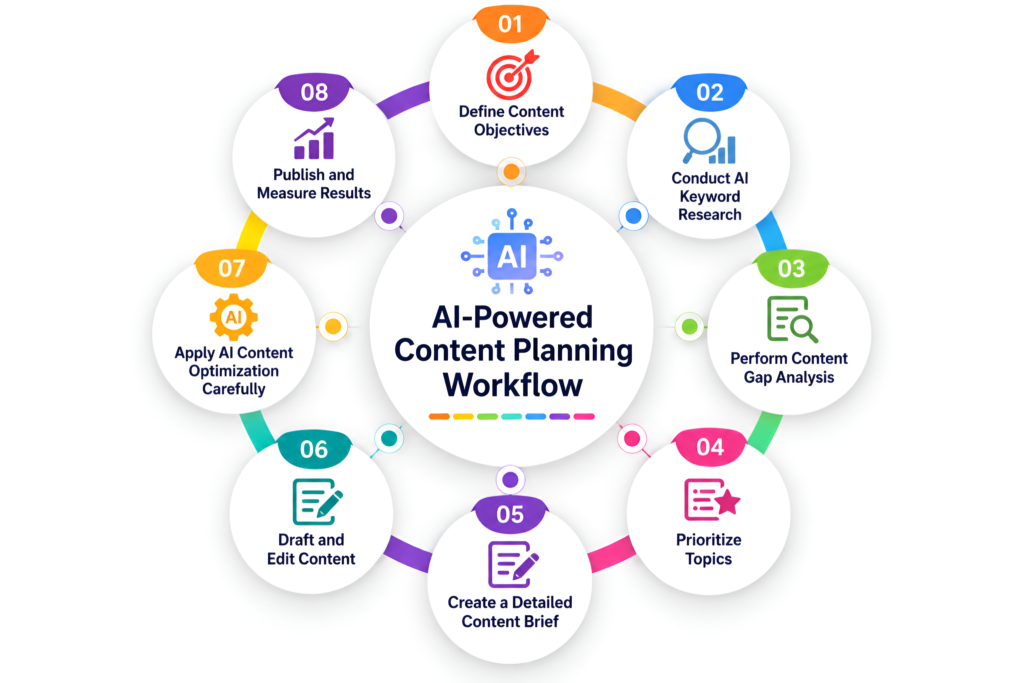 Businesses can incorporate AI into their existing content process by following a structured workflow.
Step 1: Define content objectives: Identify whether the priority is organic traffic, qualified leads, brand visibility, service-page performance, or topical coverage.
Step 2: Conduct AI keyword research: Collect relevant queries, related terms, customer questions, and website performance data. Use AI to organize and interpret the findings.
Step 3: Perform content gap analysis: Review existing website pages and relevant competitor content to identify missing information, weak sections, and opportunities to improve existing articles.
Step 4: Prioritize topics: Evaluate search intent, audience relevance, competition, business value, and the ability to provide original insights.
Step 5: Create a detailed content brief: Define the target query, supporting keywords, headings, evidence requirements, internal links, and intended reader outcome.
Step 6: Draft and edit the content: Use suitable AI content creation tools for assistance, then add human expertise, verify claims, and improve the article’s clarity and originality.
Step 7: Apply AI content optimization carefully: Review the content’s structure, relevance, metadata, internal links, and coverage of important user questions.
Step 8: Publish and measure results: Monitor search performance and conversions, then update content based on evidence and changing audience needs.
This workflow allows marketing teams to benefit from AI-assisted efficiency while maintaining editorial control and a clear SEO content strategy.
Common Mistakes to Avoid When Using AI for SEO
AI can improve efficiency, but poor implementation can reduce content quality and waste marketing resources.
- Publishing unedited AI-generated content: Drafts may contain inaccuracies, repetitive language, or unsupported claims.
- Targeting keywords without checking search intent: A keyword may attract the wrong audience if the content does not match the user’s needs.
- Ignoring content gap analysis: Publishing new articles without reviewing existing pages can create duplication and overlapping topics.
- Overusing keywords: Forced repetition makes content difficult to read and does not guarantee better rankings.
- Relying entirely on automation: AI cannot independently replace business knowledge, editorial judgment, or first-hand experience.
- Publishing content without a clear purpose: Every page should serve an identifiable audience need and fit the broader content strategy.
- Expecting guaranteed AI search rankings: No tool can ensure that content will appear in every AI assistant’s answers.
The best approach combines AI capabilities with human expertise, reliable evidence, and ongoing performance measurement.
Conclusion
AI-powered content planning helps businesses improve keyword research, identify content gaps, and create optimized content for better search visibility. By combining AI tools with human expertise, businesses can build an effective SEO content strategy for traditional search engines and AI platforms.
Want to improve your website’s SEO and AI search visibility? Contact Sensation Solutions to discuss a content strategy tailored to your audience, services, and business goals.
Frequenty Asked Questions
What Are the Best Practices for Using AI in SEO Content Planning?
Use AI for research, topic clustering, and content optimization, while verifying facts, adding original insights, and prioritizing user needs.
Can AI Improve Keyword Research and Content Topic Selection?
Yes, AI keyword research helps identify related search queries, audience questions, and relevant content opportunities based on search intent.
How Do AI Content Creation Tools Improve Content Quality?
AI content creation tools assist with outlines, drafts, and editing, helping marketers create clear, well-structured content with human review.
How Does AI Content Optimization Support Better Search Visibility?
AI content optimization helps improve content relevance, readability, headings, and topic coverage, supporting a stronger SEO content strategy.