CMS Development Services in 2026: Why Modern Businesses Need a Scalable Content Management System

Table of Contents
Today’s businesses are expected to do more than ever online: publish content quickly, update websites often, personalize every visitor’s experience, and stay visible across dozens of channels at once. Trying to manage all of that through static websites or systems that depend on a developer for every small change quickly creates bottlenecks and slows growth.
That’s why companies across nearly every industry are turning to CMS development services. A modern Content Management System (CMS) gives businesses one central platform to manage website content, digital assets, landing pages, blogs, product information, and customer experiences, all without needing deep technical skills.
As digital transformation speeds up, a scalable CMS is no longer just a nice-to-have website tool. It has become core business infrastructure. Whether you work in eCommerce, healthcare, education, finance, manufacturing, or professional services, how efficiently you manage content directly shapes your marketing results, customer engagement, and overall growth.
The scale of this shift is significant. Industry research projects that the global content management software market will surpass $120 billion by the end of the decade, driven by businesses investing in digital-first experiences and content-led marketing.
What Is CMS and Why Do You Use It?
A Content Management System (CMS) is software that lets you create, edit, organize, and publish website content without writing code. Instead of waiting on developers for every update, your marketing team, content managers, and other staff can manage pages, blogs, images, videos, and product details directly through a simple, visual interface.
Today’s platforms go well beyond basic editing. Modern CMS solutions add capabilities like workflow automation, built-in SEO tools, content scheduling, role-based access controls, analytics integrations, and publishing across multiple channels. Businesses adopt them because they make website management easier while offering more flexibility, scalability, and day-to-day efficiency.
What Is the Main Purpose of a CMS?
The main purpose of a CMS is to simplify content management while keeping you in full control of your digital presence.
With a CMS, you no longer have to edit website code by hand every time something needs to change. Instead, you create and publish content through an intuitive dashboard that handles the technical side for you.
For a growing business, that means faster updates, less reliance on developers, smoother collaboration between teams, and a more agile digital marketing strategy.
Why Businesses Are Investing in CMS Development Services
Digital experience is now one of the biggest factors in whether a business wins and keeps customers. To stay competitive, companies need websites that can adapt fast, to shifting customer expectations, new search engine rules, and evolving marketing campaigns. Professional CMS development services help you build a platform shaped around your specific needs, rather than forcing your business into a generic, off-the-shelf template.
A custom CMS gives you far more room to grow. It makes it easier to manage complex content structures, connect third-party applications, run multilingual websites, and scale your digital operations as your business expands.
For all these reasons, more companies are partnering with a dedicated CMS development company to build content platforms that are secure, scalable, and ready for whatever comes next, all aligned with their long-term goals.
What Is a Key Advantage of Using a CMS for Businesses?
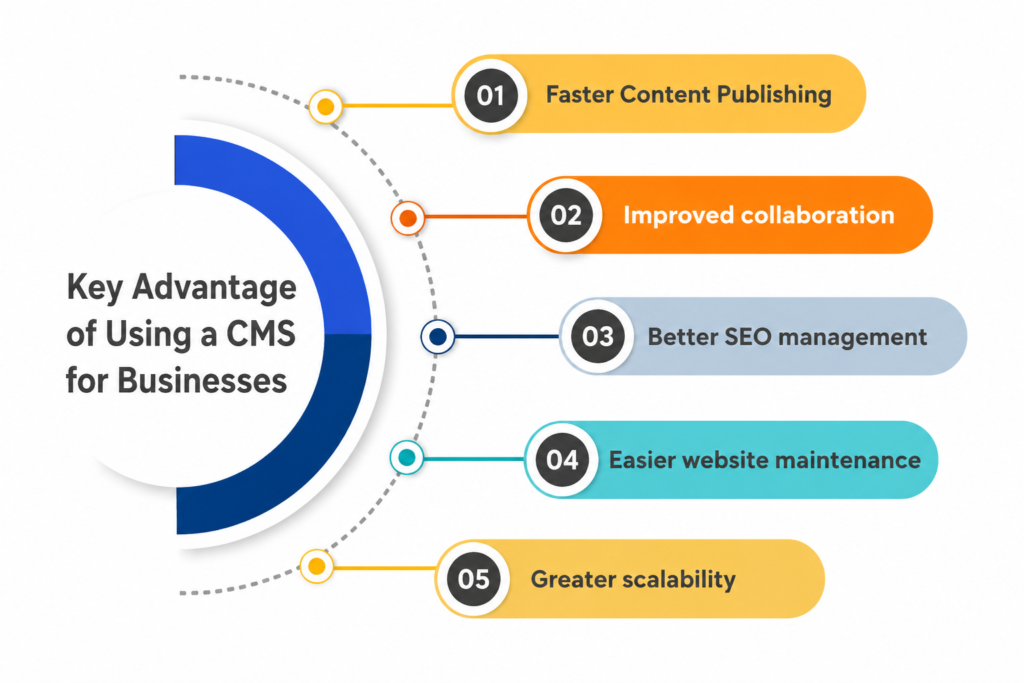
The single biggest advantage of a CMS is operational efficiency. Without one, even minor website tweaks often require technical help, which causes delays and drives up maintenance costs. A CMS puts that control back in your team’s hands, letting them update content independently while keeping the whole site consistent.
Key benefits include:
Greater scalability – grow your content and site without starting over
Faster content publishing – get updates live in minutes, not days
Improved collaboration – multiple team members can work together smoothly
Better SEO management – optimize content with built-in tools
Lower development costs – reduce reliance on developers for routine changes
Easier website maintenance – manage everything from one place
Stronger content governance – control who can edit and publish
Together, these advantages help businesses respond faster to market shifts and changing customer needs.
Most Popular CMS Platforms Used in 2026
The CMS landscape keeps evolving as businesses look for more flexibility, better performance, and deeper personalization. Some of the most widely used platforms today include:
- WordPress
- Drupal
- Joomla
- Shopify
- Adobe Experience Manager
- Contentful
- Strapi
- Webflow
- HubSpot CMS
- Kentico
Each one suits a different type of business, depending on how complex your content is, how much you need to scale, your security requirements, and the technical resources you have on hand.ave on hand.
Which CMS Is Most Used?
WordPress remains the most widely used CMS in the world, thanks to its flexibility, huge plugin ecosystem, and beginner-friendly interface.
Because it powers a large share of all websites, WordPress continues to be a go-to choice for businesses, publishers, schools, and eCommerce brands alike.
That said, larger enterprises often reach for platforms like Adobe Experience Manager, Drupal, or headless CMS solutions when they need to support more complex digital ecosystems.
What Are Some Common CMS Systems?
Different platforms tend to dominate different use cases. WordPress is the popular choice for corporate websites and content marketing. Shopify leads the way for eCommerce stores. Drupal is trusted for enterprise-grade security and scalability, while headless platforms like Contentful and Strapi are increasingly used to deliver omnichannel digital experiences. The right fit for you comes down to your growth strategy, technical requirements, and content goals, not simply which name is most familiar.
CMS vs Traditional Website Development
Many businesses still rely on static websites that require developers to make content updates. While this approach may work for smaller projects, it often becomes inefficient as content demands increase.
| Feature | CMS Website | Traditional Website |
|---|---|---|
| Content Updates | Easy | Developer Dependent |
| Scalability | High | Limited |
| SEO Management | Built-In Tools | Manual |
| User Access Control | Advanced | Limited |
| Publishing Speed | Fast | Slower |
| Content Collaboration | Easy | Difficult |
| Ongoing Maintenance | Lower | Higher |
Overall, a scalable CMS offers more flexibility and better long-term cost efficiency than managing a traditional website by hand.
How AI Is Transforming CMS Development Services
Artificial intelligence is quickly becoming a driving force in content management and digital experience. More and more CMS platforms now build in AI-powered features that help businesses automate workflows, personalize experiences, sharpen SEO, and understand customer behavior.
AI-enabled CMS solutions can help with:
- Content recommendations
- SEO optimization
- Audience segmentation
- Content tagging
- Automated translations
- Personalization engines
- Predictive analytics
According to Gartner and other technology analysts, AI-driven content management will keep expanding as businesses look for greater efficiency and stronger engagement across every digital channel.
What Is the Best CMS for Beginners?
For beginners and small businesses, WordPress is usually the most approachable option. Its simple interface, large support community, and vast library of plugins and customization options make it easy to use, even with little technical experience.
Still, popularity isn’t everything. Businesses with specific operational needs may be better served by a custom CMS built by experienced developers who can tailor the functionality to exactly how they work. In the end, the best CMS is the one that fits your goals, not just the one most people happen to use.
Why SEO Matters in CMS Development
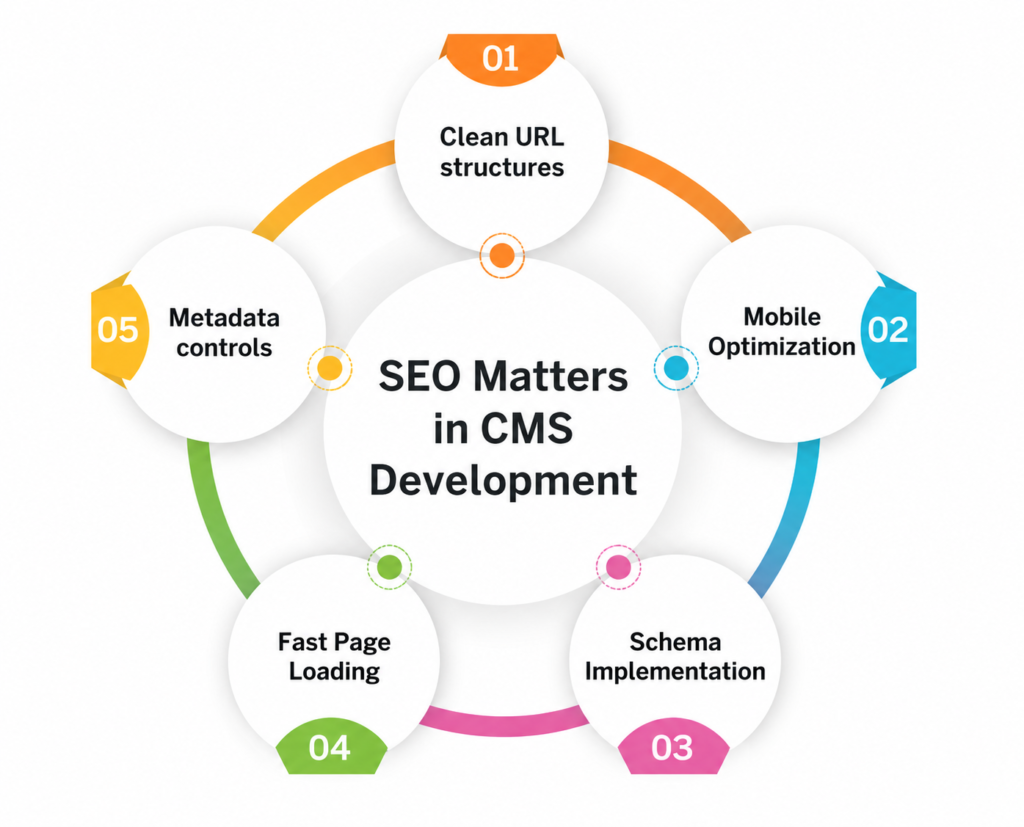
Your CMS plays a major role in how visible you are on search engines. Search engines reward sites that load fast, are mobile-friendly, use well-structured content, and deliver a smooth user experience, and a well-built CMS makes all of that far easier to manage.
SEO-friendly CMS development typically includes:
- Clean URL structures
- Schema markup implementation
- Mobile optimization
- Fast page loading
- Content hierarchy management
- Metadata controls
- Internal linking capabilities
These features help you improve organic visibility and build a foundation for lasting digital marketing success.lp you improve organic visibility and build a foundation for lasting digital marketing success.
How to Choose the Right CMS Development Company
The development partner you choose can make or break your project. Before committing, it’s worth evaluating providers on their technical expertise, industry experience, ability to customize, ongoing support, and long-term scalability planning.
When comparing CMS development companies, look closely at:
- Portfolio and case studies
- Depth of CMS platform expertise
- Custom development capabilities
- SEO knowledge
- Security practices
- Integration experience
- Post-launch support
The right partner won’t just meet your needs today, they’ll help you build a CMS that keeps supporting your business as it grows.
Why Businesses Choose Sensation Solutions for CMS Development Services
Businesses that want a scalable, customized CMS increasingly turn to Sensation Solutions to build secure, SEO-friendly platforms designed around real business goals.
As a trusted CMS development partner, Sensation Solutions helps organizations create tailored content management systems that boost website performance, simplify day-to-day administration, and support long-term digital growth.
From WordPress builds and enterprise CMS implementations to fully custom systems and AI-ready digital platforms, Sensation Solutions designs every solution around your objectives, never a one-size-fits-all template.
Future Trends Shaping CMS Development in 2026
The future of CMS development is being shaped by artificial intelligence, headless architecture, personalization technology, and omnichannel content delivery. Some of the most important trends to watch include:
- AI-powered content management
- Headless CMS adoption
- Voice search optimization
- Personalized content delivery
- Omnichannel publishing
- Advanced content analytics
- API-first architecture
- Stronger cybersecurity frameworks
Businesses that invest in a modern CMS now will be far better positioned to meet future digital demands, and to stay ahead of the competition.
CMS Development Have Evolved
CMS development has come a long way from simple website management. Today, a content management system sits at the heart of your digital marketing, customer engagement, SEO performance, and online growth.
As digital transformation continues to take priority, investing in a scalable CMS becomes essential for staying agile, streamlining content workflows, and delivering standout customer experiences. Contact us today to see how the right CMS solution can help your business stay competitive and grow over the long term.
If you’re aiming for long-term scalability, stronger content management, and future-ready digital infrastructure, partnering with an experienced CMS development company, one that can build a custom solution around your growth goals, is a smart next step.
Frequently Asked Questions
What is the difference between a CMS and a traditional website?
A CMS enables users to update content through a management interface, while traditional websites often require manual coding and developer support for content changes.
Which CMS is best for SEO?
WordPress is often considered one of the most SEO-friendly CMS platforms due to its flexibility, plugin ecosystem, and optimization capabilities. However, custom CMS solutions can also provide excellent SEO performance when developed correctly.
Do businesses need custom CMS development?
Businesses with complex workflows, unique content requirements, or enterprise-level scalability needs often benefit from custom CMS development rather than relying solely on off-the-shelf platforms.
Why choose a CMS development company?
A professional CMS development company provides expertise in customization, integration, security, scalability, and performance optimization, ensuring the CMS supports long-term business growth.